George Washington Freemasonry shaped his character and public life, from his 1752 initiation at Fredericksburg to the Masonic tributes paid at his death.
Initiation and Early Years
George Washington’s involvement with Freemasonry spanned nearly his entire adult life. The Masonic Lodge at Fredericksburg, Virginia, initiated him as an Entered Apprentice on November 4, 1752, when he was twenty. It advanced him to Fellow Craft on March 3, 1753, and to Master Mason on August 4, 1753. The entire process took roughly nine months, a common pace for the era.
Freemasonry During the Revolution
Records of Washington’s Masonic activity in his younger years are sporadic, largely because his military and surveying duties frequently took him away from Fredericksburg. During the Revolutionary War, however, Masonic fraternity became a visible thread running through his years in command. Lodges in Massachusetts, New York, New Jersey, and Pennsylvania recorded him attending Masonic celebrations and religious observances, including St. John the Baptist and St. John the Evangelist feast days. He also supported the traveling military lodges that had formed within several Continental Army regiments.
The Masonic Apron
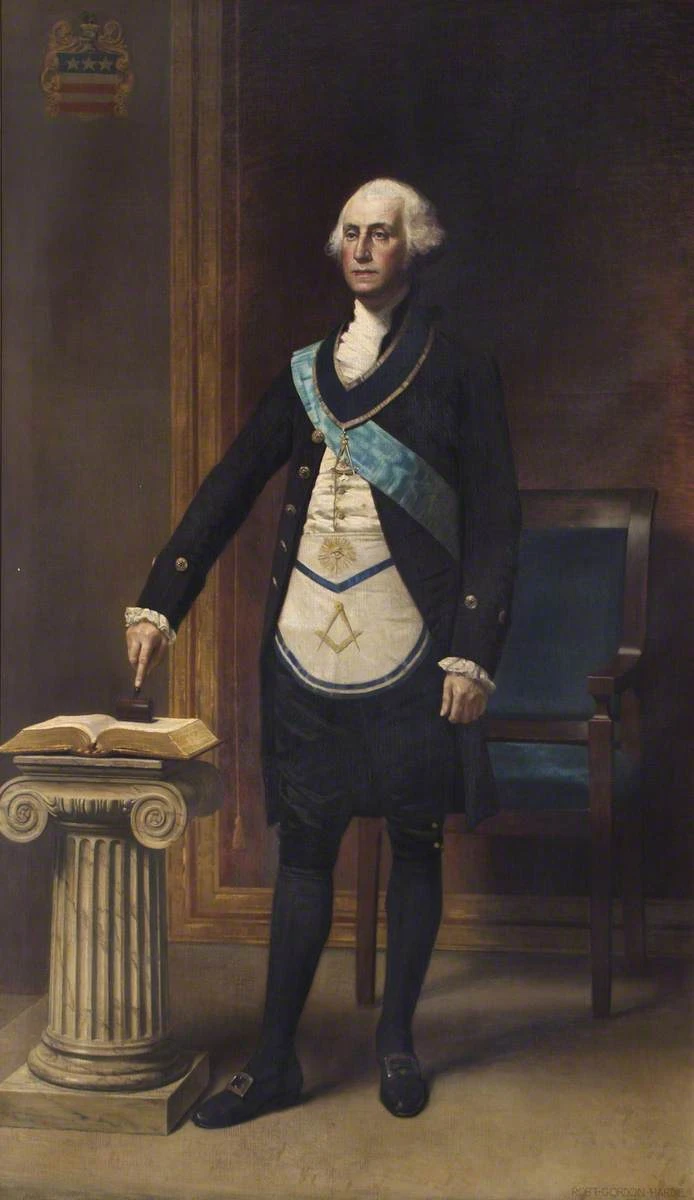
In 1782, two commercial agents living in France, one American and one French, sent Washington an ornately embroidered silk Masonic apron and sash as a gift. Washington wrote back to thank them. Historians generally agree that he wore this apron eleven years later at one of the most famous Masonic moments of his public life: the laying of the cornerstone of the United States Capitol on September 18, 1793. Lodges under the Grand Lodges of Maryland and Virginia jointly conducted that ceremony, with Washington presiding as Acting Master. The apron remains today in the collection of Alexandria-Washington Lodge No. 22.
Alexandria-Washington Lodge No. 22
That lodge held particular significance for Washington. In early 1788, a committee from Alexandria’s lodge asked him to serve as its “Charter Master” as the lodge sought a new charter from the Grand Lodge of Virginia rather than Pennsylvania. Washington agreed. The Grand Lodge granted the charter on April 28, 1788, naming him the lodge’s Worshipful Master. Alexandria-Washington Lodge No. 22 has held that title ever since and continues to honor it today.
Freemasonry and the Presidency
Freemasonry also touched Washington’s presidency in visible ways. At his first inauguration in New York City on April 30, 1789, he took his oath of office on a Bible belonging to St. John’s Lodge No. 1. Robert R. Livingston, who was both New York’s Chancellor and its Grand Master of Masons, administered the oath. Throughout his two terms, Washington received Masonic delegations and congratulatory addresses from lodges and Grand Lodges across the new nation. He consistently replied with warmth toward the fraternity, writing to one lodge in 1790 that he would “always be happy to advance the interests of the Society, and to be considered by them as a deserving brother.”
Death and Masonic Tribute
Freemasonry accompanied Washington to the end of his life. He died at Mount Vernon on December 14, 1799. Four days later, members of Alexandria Lodge No. 22 conducted a Masonic funeral ceremony alongside the Anglican burial rite. In the months that followed, Masonic lodges throughout the country and even abroad — including a French-speaking lodge in Philadelphia — held formal Lodges of Sorrow in his memory. The Grand Lodge of Massachusetts requested and received a lock of his hair, which it still preserves in a gold urn crafted by Paul Revere. Today, the George Washington Masonic National Memorial in Alexandria, Virginia, stands as the fraternity’s enduring tribute to its most famous member.