Election and Inauguration
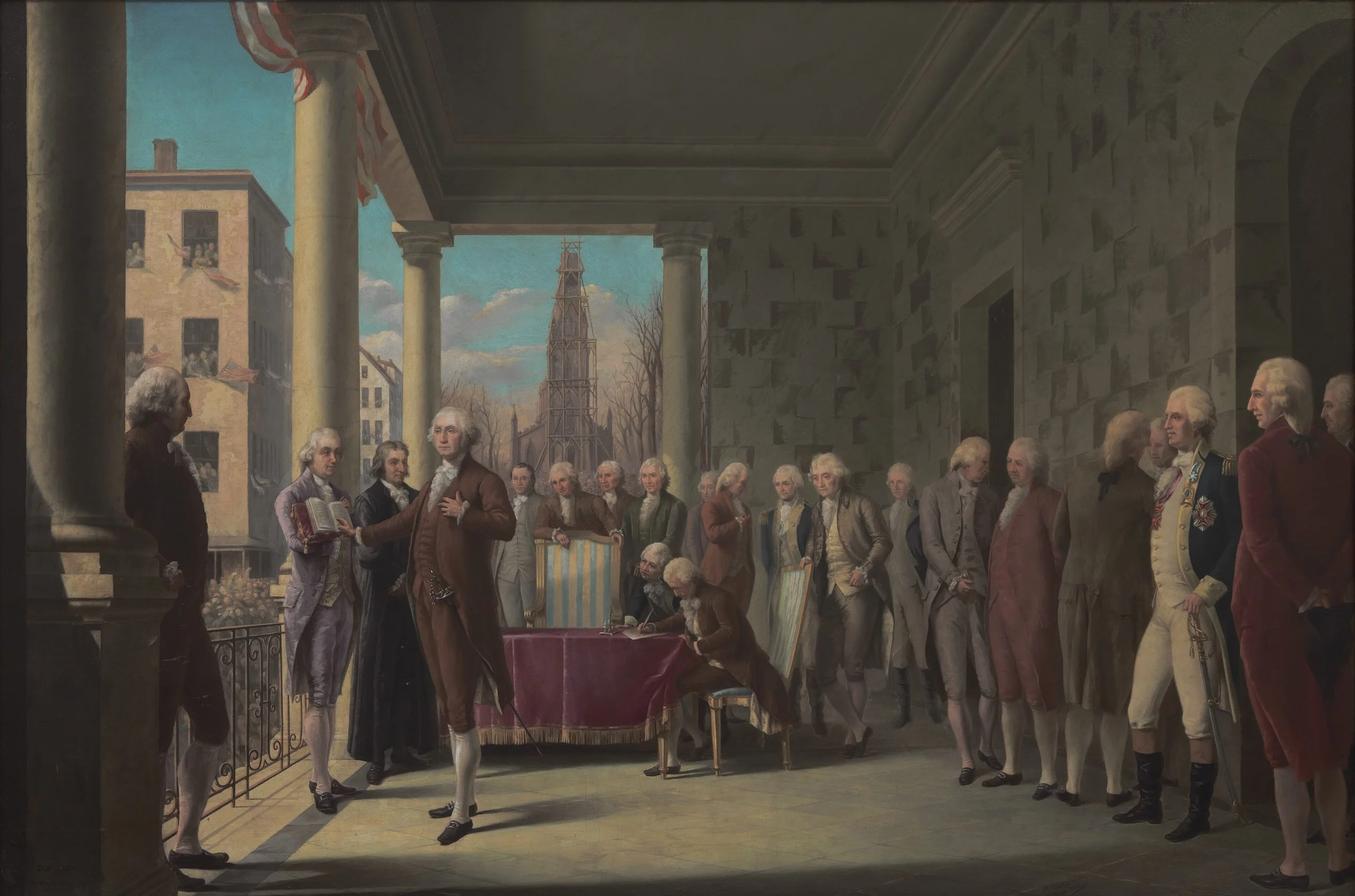
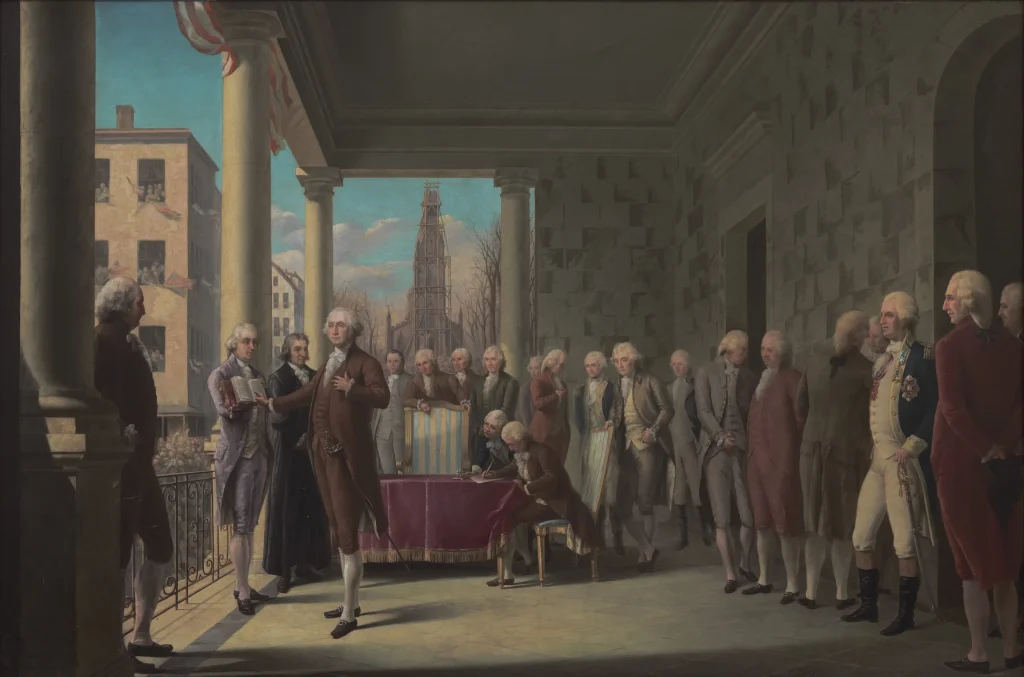
Washington had hoped to spend his remaining years as a private citizen at Mount Vernon. But the weakness of the government under the Articles of Confederation drew him back into public life. He presided over the Constitutional Convention in Philadelphia in the summer of 1787. When the new Constitution took effect, the Electoral College unanimously chose him as the nation’s first president on February 4, 1789. He remains the only president in American history elected without opposition. He took his oath of office in New York City, then the seat of government, on April 30, 1789. For the ceremony, he used a Bible borrowed from a New York Masonic lodge.
Building a New Government
As the first occupant of an office the Constitution defined only in outline, Washington understood that nearly everything he did would become precedent. He assembled the first presidential cabinet. It included Thomas Jefferson as Secretary of State, Alexander Hamilton as Secretary of the Treasury, Henry Knox as Secretary of War, and Edmund Randolph as Attorney General. He signed the Judiciary Act of 1789, establishing the federal court system and the Supreme Court. He then appointed John Jay as the nation’s first Chief Justice. On January 8, 1790, he delivered the first annual address to Congress — the forerunner of today’s State of the Union address. It touched on national defense, immigration, education, and commerce.
First Term: Finances and Factions
Washington’s first term was dominated by the difficult work of establishing the young republic’s finances and legitimacy. He backed Alexander Hamilton’s controversial financial program over the objections of Jefferson and Madison. The program included the federal assumption of state Revolutionary War debts and the chartering of the First Bank of the United States. As a result, that dispute helped give rise to the nation’s first political parties — factions Washington himself distrusted and refused to formally join. Congress ratified the Bill of Rights, drafted largely by James Madison, in 1791. The Residence Act of 1790 established a new permanent federal capital along the Potomac River. Washington took a close personal interest in the project, which would later bear his name.
Second Term: Neutrality and Unrest
The Electoral College reelected Washington unanimously in 1792 for a second term, during which his administration faced escalating challenges. In 1793, war broke out between Britain and France. Washington issued the Proclamation of Neutrality, asserting the young nation’s right and intention to stay out of the European conflict. However, the policy strained relations with France’s controversial minister, Citizen Genêt, and provoked bitter domestic debate. Closer to home, in 1794 Washington personally led federalized militia into western Pennsylvania. Their target was the Whiskey Rebellion, an armed uprising against a federal excise tax, and the campaign demonstrated the new government’s willingness and ability to enforce its laws. His administration also concluded two major treaties in 1795. The Jay Treaty with Great Britain averted a renewed war, though it proved deeply unpopular with segments of the public. Pinckney’s Treaty with Spain, meanwhile, secured American navigation rights on the Mississippi River.
Farewell
Despite pressure to seek a third term, Washington chose to step aside. He established a two-term tradition that would hold for nearly a century and a half. In September 1796, he published his Farewell Address, written with help from Alexander Hamilton. It warned the country against the dangers of permanent political factions, sectional divisions between North and South, and long-term foreign alliances. Instead, it urged Americans to cultivate “the primary interests of our own country.” He left office on March 4, 1797, and John Adams, his vice president, succeeded him.