Retirement at Mount Vernon
Washington returned to Mount Vernon in March 1797 intending to live out his remaining years as a farmer. He resumed the agricultural experimentation he had always favored, rotating crops and moving away from the tobacco monoculture that had exhausted much of Virginia’s soil. In 1797, he also built one of the largest whiskey distilleries in the young United States, producing a recipe of roughly sixty percent rye, thirty-five percent corn, and five percent malted barley. He also remained engaged from a distance in the planning of the new federal capital rising on the Potomac.
Final Public Service
His retirement proved brief. In July 1798, amid rising tensions with France in the so-called Quasi-War, President John Adams appointed Washington Commander-in-Chief of a newly authorized provisional army. It was a largely symbolic appointment, given his age and the fact that hostilities never escalated to the point of requiring him to take the field. Washington’s views on slavery, meanwhile, continued to evolve privately during these final years. He sought a model of farming at Mount Vernon that would not depend on enslaved labor, and he hoped, without ever leading a public campaign on the subject, that the Virginia legislature might move toward a gradual end to slavery in the state.
Illness and Death
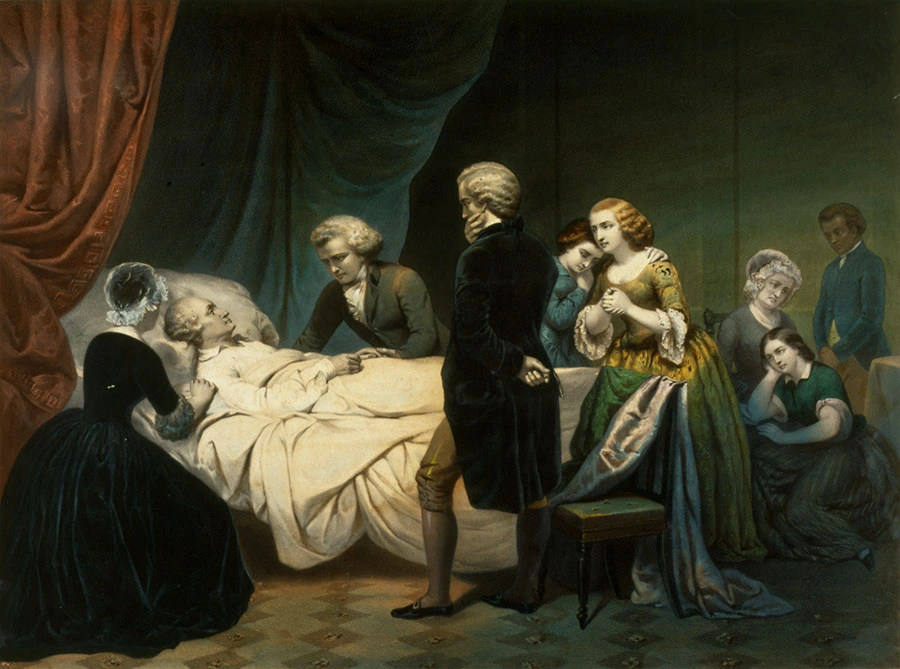
On December 12, 1799, Washington spent much of the day outdoors on horseback in cold, wet weather. He developed a severe throat infection overnight. His condition rapidly worsened over the following two days despite the efforts of three attending physicians, who treated him with the standard remedies of the era, including several rounds of bloodletting. George Washington died at his home at Mount Vernon on the night of December 14, 1799, at about 10:20 p.m. His wife Martha was at his bedside, and his secretary, Tobias Lear, recorded his final hours.
Burial and Will
He was buried at Mount Vernon on December 18, 1799, in a service that combined the Anglican Christian burial rite with a Masonic funeral ceremony performed by members of Alexandria Lodge No. 22. From his deathbed, Washington had directed Martha to burn one of his two surviving wills. The document that survived, a twenty-nine-page will, provided that his enslaved valet, William Lee, be freed immediately. It also provided that all of the more than one hundred people he personally held in bondage be freed upon Martha’s death, along with provisions for the support of those too elderly to work and for the education of freed children. He could not free the additional enslaved people at Mount Vernon who belonged to the Custis estate rather than to him outright. The will also directed funds toward several educational institutions and expressed his hope that a national university might one day help unify the country.
National Mourning and Legacy
News of Washington’s death produced an extraordinary national outpouring of grief. Congress designated his birthday, February 22, as a day of mourning. At least 231 separate public eulogies and memorial services were documented across the country in the months that followed. Before Congress, Washington’s friend and former cavalry officer Henry “Light-Horse Harry” Lee delivered the phrase that has defined Washington’s memory ever since, describing him as “first in war, first in peace, and first in the hearts of his countrymen.” Martha Washington lived at Mount Vernon until her own death on May 22, 1802. Washington’s legacy as the “Father of His Country” would go on to be invoked, often for competing purposes, throughout American history. His name endures today on the nation’s capital, a state, countless institutions, and the currency of the United States itself.