
The French and Indian War
Washington’s military career began on the Virginia frontier during the opening moves of the French and Indian War. In 1753, Virginia’s Lieutenant Governor Robert Dinwiddie sent the twenty-one-year-old Major Washington on a hazardous winter mission to the Ohio Valley. His task was to warn French forces to vacate territory claimed by Britain. The mission failed to dislodge the French. The following year, Washington, now a lieutenant colonel, led a small force that skirmished with a French detachment at Jumonville Glen. The French response forced Washington to retreat to a hastily built stockade he named Fort Necessity. There he was defeated and compelled to surrender on July 3, 1754 — the only time in his career he would surrender to an enemy.
Braddock’s Campaign and the Frontier
Washington’s reputation nonetheless grew. In 1755 he served as a volunteer aide to British General Edward Braddock during Braddock’s disastrous campaign against Fort Duquesne. At the Battle of the Monongahela, Braddock’s column was ambushed and routed, and Braddock himself was mortally wounded. Washington had two horses shot from under him and bullet holes through his coat, yet he helped organize the retreat. He emerged from the battle with a reputation for personal courage under fire. He then spent the following three years commanding the Virginia Regiment in defense of the colony’s western frontier. In 1758, he took part in the successful Forbes Expedition that finally drove the French from the forks of the Ohio.
Commander-in-Chief
Washington resigned his frontier commission at the end of 1758 to marry and manage Mount Vernon. Sixteen years later, the American Revolution called him back to arms. On June 15, 1775, the Second Continental Congress unanimously elected him Commander-in-Chief of the newly created Continental Army. The choice reflected his military experience, and also the political value of a Virginian leading what was then a largely New England conflict. He took command of the siege of Boston in July 1775. When the British evacuated the city by sea in March 1776, it marked the new army’s first major success.
Early Defeats and Trenton
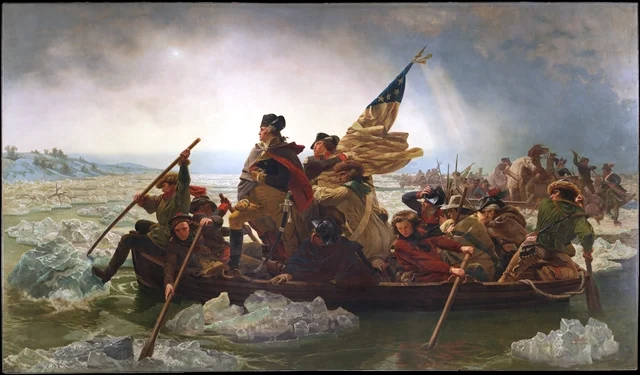
The following months brought a string of painful defeats. Washington’s forces were routed at the Battle of Long Island in August 1776. As British and Hessian troops pressed their advantage through New York and New Jersey, Washington was forced into a long retreat. He answered with one of the boldest strokes of the war. On the night of December 25–26, 1776, he led his army back across the ice-choked Delaware River and surprised a garrison of Hessian troops at Trenton. Days later, he won another victory at Princeton. The twin victories revived a flagging cause and restored confidence in Washington’s leadership at a critical moment.
Valley Forge and the Path to Victory
The war’s fortunes continued to swing. British victories at Brandywine and Germantown in the fall of 1777 allowed the British to occupy Philadelphia. Washington’s army then endured a brutal winter encampment at Valley Forge, Pennsylvania, from December 1777 to June 1778 — a period of severe shortages and suffering that also saw the army reshaped into a more disciplined force under the training of Baron von Steuben. The 1778 alliance with France brought crucial naval and military support to the American cause, and the war gradually shifted southward. In 1783, with the army encamped at Newburgh, New York, Washington personally defused a brewing mutiny among his unpaid officers — the Newburgh Conspiracy. In an emotional address, he paused to put on a pair of reading glasses, remarking that he had “grown gray” and “almost blind” in his country’s service. It moved several officers to tears and ended the threat of an officer revolt against civilian authority.
Yorktown and Resignation
The war’s decisive campaign came at Yorktown, Virginia. In October 1781, Washington’s combined American and French forces, supported by the French navy’s control of the Chesapeake, trapped General Lord Cornwallis’s army and forced its surrender on October 19, 1781 — effectively ending major fighting. The Treaty of Paris formally concluded the war on September 3, 1783. That December, Washington bid an emotional farewell to his officers at Fraunces Tavern in New York City. He then traveled to Annapolis, Maryland, where the Continental Congress was sitting, and voluntarily resigned his military commission on December 23, 1783. It was a deliberate act of surrendering power that stunned contemporaries in Europe and cemented Washington’s reputation, then and since, as a modern Cincinnatus.